Before the Recipe Book: How Coastal Cooking Knowledge Was Shared
Coastal cooking knowledge grew from watching tideside work, shared tasks and local cues. Learn how those habits carried kitchen skills across generations.
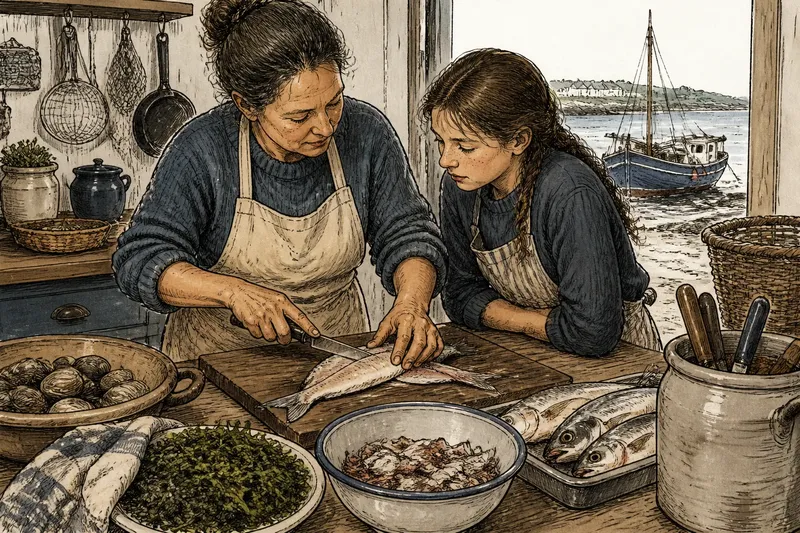
Coastal cooking knowledge was often learned beside the work it served: cleaning a catch, salting fish, or preparing a meal around a boat’s return. Before a recipe could name quantities, a learner had to notice what the day had brought in and what the kitchen could preserve or cook at once.
That made instruction practical and local. A cook might explain how to handle a particular fish, while a neighbor’s method differed because the species, weather, fuel, or household routine did. The knowledge passed on was not a single coastal tradition but a set of judgments tied to place and labor.
What could a learner see in a working coastal kitchen?
Much of the lesson began before a pan reached the stove. A learner might watch someone sort shellfish, rinse sand from greens, lay out a knife and board, or keep a bowl ready for scraps. Those arrangements reflected the work at hand: a slippery fish needed a stable board, while a batch of small shellfish called for repeated sorting.
Coastal kitchens also had to fit around changing work. If a boat came in late or weather delayed a trip, food preparation could shift; a cook might salt, smoke, dry, or chill what could not be used straight away, depending on local practice and available conditions. The learner saw that cooking began with decisions about timing and keeping food in usable condition, not simply with a recipe.
Watch how the cook handles the ingredient before asking about the seasoning.
How did local work shape what people learned?
Knowledge followed the food and the labor around it. In fishing communities, one person might learn to mend or prepare gear while another cleaned the catch; in places with shore gathering, sorting and rinsing could be as familiar as stirring a pot. Household roles varied, so no single account describes every coastal kitchen.
Seasonality mattered as a practical constraint. A cook’s decisions depended on what was arriving locally, what could be kept, and how many people needed feeding. A learner therefore absorbed more than a method: they learned to adjust the meal when a familiar ingredient was absent or the day’s work ran late.
Imagine a household expecting a fresh catch for supper, but the boat returns with a different fish than planned. The learner watches the cook set aside the intended recipe, check the new fish’s shape and firmness, then choose a cooking method suited to its pieces; the observable result is a meal built around the catch actually available, with the original dish postponed rather than forced.
How can a week of kitchen learning unfold?
A short routine can make observation and practice easier without turning a family meal into a formal class. Keep the focus on one ingredient or task, and let the cook explain choices as the work allows.
- Day one: Follow the ingredient. Watch where it came from, how it is sorted, and what is discarded. If the cook distinguishes usable pieces from scraps, ask what visible feature makes the difference.
- Day two: Observe preparation. Notice the tools and order of work, such as a fish knife, a sturdy board, and a bowl for trimmings. If a tool changes during the task, ask what problem the new one solves.
- Day three: Take on a supporting job. Rinse greens, set out bowls, or prepare serving dishes. If the task creates a bottleneck, ask where the cook would rather have help next time.
- Day four: Try one technique. Under guidance, practice a familiar action such as turning fish in a pan or stirring a pot. If the food breaks or sticks, pause and ask what cue the cook would watch before trying again.
- Day five: Listen for a decision. Pay attention to the moment the cook changes heat, covers a pot, or stops stirring. If the cue is unclear, ask what changed in the sound, smell, or appearance.
- Day six: Handle a short sequence. Prepare the tools, complete a task, and clear the work area while the cook remains available. If you hesitate at a particular point, identify that point rather than guessing your way through it.
- Day seven: Explain the method back. Describe the order of actions and the cues behind them. If the cook corrects a detail, add the correction to your notes instead of treating the first version as fixed.
Fit the routine around work and household needs. The important part is returning to the same ingredient or technique long enough to connect a cue with a decision.
Why did spoken cues matter more than fixed times?
A phrase such as “wait until it settles” makes more sense beside the pot than on a page. The cook can point to a change in bubbling, smell, or texture and explain why the next action follows from it. A timer may still be useful, but it cannot describe every difference in ingredients, cookware, or heat.
Memory linked those cues to repeated actions. It was not perfect storage: people adapted, forgot details, and disagreed. But doing the work again could make a sequence familiar, from arranging tools to judging whether a piece was ready to turn.
Keep a note of the cue and the action it prompted, not just the time.
What should a learner ask about coastal cooking knowledge?
How did people decide what to cook from the day’s catch?
They considered what had arrived, what the household could use promptly, and what local methods could preserve for later. The exact decision varied by place, species, conditions, and household practice.
How can I learn a skill that depends on touch or smell?
Ask the cook to demonstrate the ingredient at different stages, then try the same task while they are present. Describe what you notice and let them connect your observation to the next action.
What if two relatives remember a method differently?
Ask each person to demonstrate the version they know and point out where the actions differ. The variations may reflect different ingredients, tools, or household habits rather than a simple error.
Can notes preserve a method based on sound or appearance?
Notes can record the cook’s words, the setting, and the decision that followed. They cannot recreate a changing kitchen sound or the feel of an ingredient, so treat them as prompts for another demonstration.
How can a learner record a lesson without flattening it?
Write down the ingredient, the tool, the cue, and the action that followed. A sketch of how a fish was arranged on a board or a note about a pot’s sound may be more useful than a bare instruction to “cook until ready.”
Ask permission before recording someone’s voice or photographing a family method. Leave room for variations in species, season, equipment, and personal preference; coastal cooking knowledge is often most accurate when it explains what to notice rather than pretending every kitchen follows one script.
When recording coastal cooking knowledge, note the place and ingredient as carefully as the technique. That small detail helps a future learner understand why a method made sense there, without mistaking one household’s practice for a rule of the coast.