The Briny Edge: Why Sea Vegetables Taste So Distinctive
Sea vegetables taste distinctive because their savoury, mineral notes concentrate in small amounts. Learn how to season soups, grains and sauces without overwhelming them.
Sea vegetables taste distinctive because a little can bring salt, savouriness and a faint mineral impression to a whole dish. Used as seasoning, kelp, nori and dulse can sharpen broth or grains without turning dinner into a bowl of seaweed.
What creates the briny taste?
Sea vegetables grow in salt water, but their flavour is not simply seawater trapped in a leaf. Their naturally occurring salts and savoury compounds combine with the aroma of the dried plant, giving many varieties a rounded, almost broth-like taste. The impression may suggest the shore, but it need not taste like a mouthful of ocean.
That savoury quality is often described as umami. In cooking, umami gives a dish depth and persistence: the flavour lingers after the first bite instead of vanishing as soon as the salt does. Sea vegetables can supply that quality alongside a distinct marine aroma, which is why they are more than a salty garnish.
Mineral notes are harder to pin down. Depending on the variety and how it is processed, a sea vegetable may seem faintly iron-like, earthy or clean and saline. Those impressions are subtle; heavy seasoning can bury them beneath plain salt.
Why does the form matter?
Dried sea vegetables are concentrated and keep well, so cooks commonly use them to season rather than fill a plate. A whole strip of kelp releases flavour gradually into a simmering liquid; a pinch of flakes spreads more quickly. Nori, familiar as a crisp sheet around rice, has a toasty, savoury side that works well when crumbled over food.
Dulse offers a more assertive, often gently smoky taste. It can be torn into flakes and added near the end of cooking, where its character remains legible. Sea lettuce is lighter and can bring a green, marine note to dressings or salads. Names and flavour descriptions are guides, not promises: drying, roasting and packaging all affect what reaches the pan.
Pay attention to texture as well as flavour. A tough strip may suit a pot of broth that will be strained, while delicate flakes are easier to distribute over finished food. If the package gives preparation instructions, follow them; for product-specific limits or handling questions, use the label or ask the manufacturer.
How can a small amount season a dish?
Think of sea vegetables as a seasoning with several jobs. They can add marine aroma, deepen savouriness and contribute salt, though not every product is equally salty. Taste the dish before adding more salt, particularly if the sea vegetable has been salted or seasoned already.
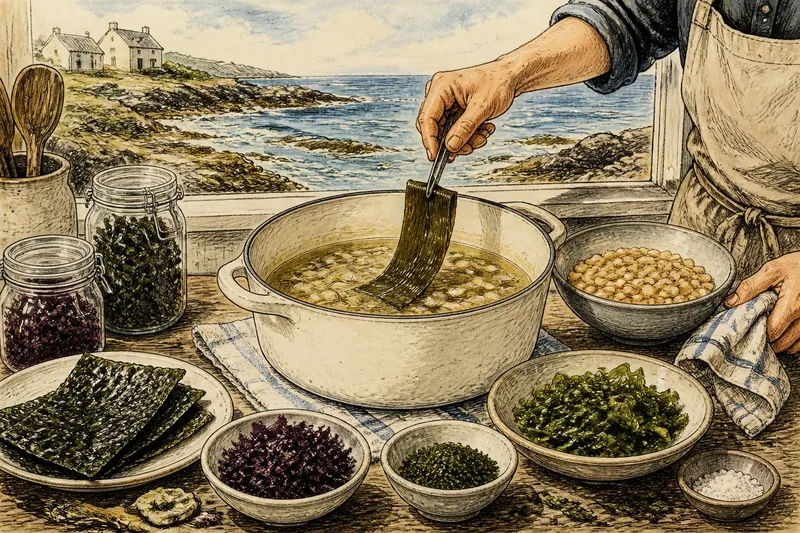
- Broth: Simmer a piece of kelp with stock or water, then remove it if the flavour has reached the level you want.
- Rice or grains: Stir a little crumbled nori or dulse through warm grains, then taste before adding salt or soy sauce.
- Beans: Add kelp to a pot as it cooks for a quiet savoury background, or finish with flakes for a more noticeable accent.
- Dressings: Whisk fine seaweed flakes into a modest amount of vinegar, oil and mustard so they disperse rather than gather in one briny clump.
- Vegetables: Scatter toasted nori over roasted cabbage, potatoes or mushrooms just before serving, where its crispness can survive.
Imagine a cook making plain white beans with onion and broth. They add a small strip of kelp while the pot simmers, remove it when the beans are tender, and taste before salting; the expected result is a fuller, subtly savoury broth rather than an obvious layer of seaweed flavour.
How do you keep the flavour in balance?
Use the mildest form that suits the dish, then add more only after tasting. Fine flakes are easy to scatter, but also easy to overdo: a pinch that disappears into a large pot may dominate a small bowl. For a first attempt, season the portion on the plate instead of committing the whole pan.
Balance depends on what else is present. Acid from lemon or vinegar can make a briny note feel brighter; butter or oil can soften its edges. Strongly salted ingredients such as soy sauce, cured seafood or salty stock can crowd out the more delicate mineral character, so add those cautiously and taste in between.
Heat changes the impression, too. Long simmering draws flavour from a sturdy piece of kelp into liquid, while crisp nori is best added at the end if you want its toasted aroma and texture to remain distinct. There is no need to make every dish taste overtly marine. Often the better seasoning is the one that makes the broth seem more complete without announcing its source.
Which sea vegetable suits which use?
Match the form to the task rather than treating every sea vegetable as interchangeable:
- Kelp: Useful for infusing soups, broths and beans; remove the piece if you want the liquid seasoned but not the kelp itself served.
- Nori: Handy as a crisp sheet or a fine finishing crumble for rice, vegetables and soups.
- Dulse: A bold option for finishing grains, eggs or vegetables when a noticeable savoury, lightly smoky accent is welcome.
- Sea lettuce: A lighter choice for salads and dressings, especially when a strong roasted flavour would compete with the other ingredients.
Start with one variety at a time. That makes it easier to notice whether a dish needs more marine aroma, more savouriness or simply less salt.
What do cooks ask about sea vegetables?
Are sea vegetables the same as seaweed?
“Sea vegetables” is a common food term for edible marine algae, while “seaweed” is the broader familiar name. The labels may overlap, so the package is the useful guide to the particular product and its intended preparation.
Should you rinse dried sea vegetables?
Some products are ready to use, while others call for rinsing or soaking. Check the package directions, since preparation can affect both texture and how much salt reaches the dish.
Can sea vegetables replace salt?
They can contribute salt and savouriness, but they are not a predictable one-for-one substitute for table salt. Season gradually and taste, especially when the product is salted or the recipe already includes salty ingredients.
Why does one sea vegetable taste stronger than another?
Species, drying, roasting, cut size and storage all shape the flavour that ends up in the kitchen. A strongly scented product may need only a trace, while a mild one may be more useful for a gentle broth infusion.
The briny edge is most useful when it stays an edge: a small, deliberate accent that lends a dish savoury depth without taking over. For sea vegetables as seasoning, begin with a little, choose a form suited to the cooking method, and taste before reaching for the salt cellar.